AI and Law Forum 2026: How AI is Reshaping Legal Practice and Education
The AI and Law Forum 2026, organised by BAC Education and UNIMY, brought together students, practitioners, and industry leaders for a timely discussion on how artificial intelligence is reshaping legal education, legal work, and the wider administration of justice. The forum was designed to move the conversation beyond fear and towards responsible adaptation. The central message that emerged was clear, AI is already part of the legal landscape, and the more pressing issue is not whether it will enter the profession, but how the profession will respond while preserving judgment, accountability, and human value.
A strong theme throughout the forum was that AI should be understood as a tool for augmentation rather than replacement. Raja Singham framed the issue in terms of relevance, arguing that while lawyers are unlikely to be replaced by AI itself, those who refuse to engage with it may be displaced by those who do. He stressed that the value of the future lawyer will no longer rest mainly on access to knowledge, since information is now easier to retrieve and process, but on the exercise of judgment, ethics, and discernment. This position was reinforced across the sessions, particularly in the view that law remains a human system built on responsibility, consequence, and interpretation.
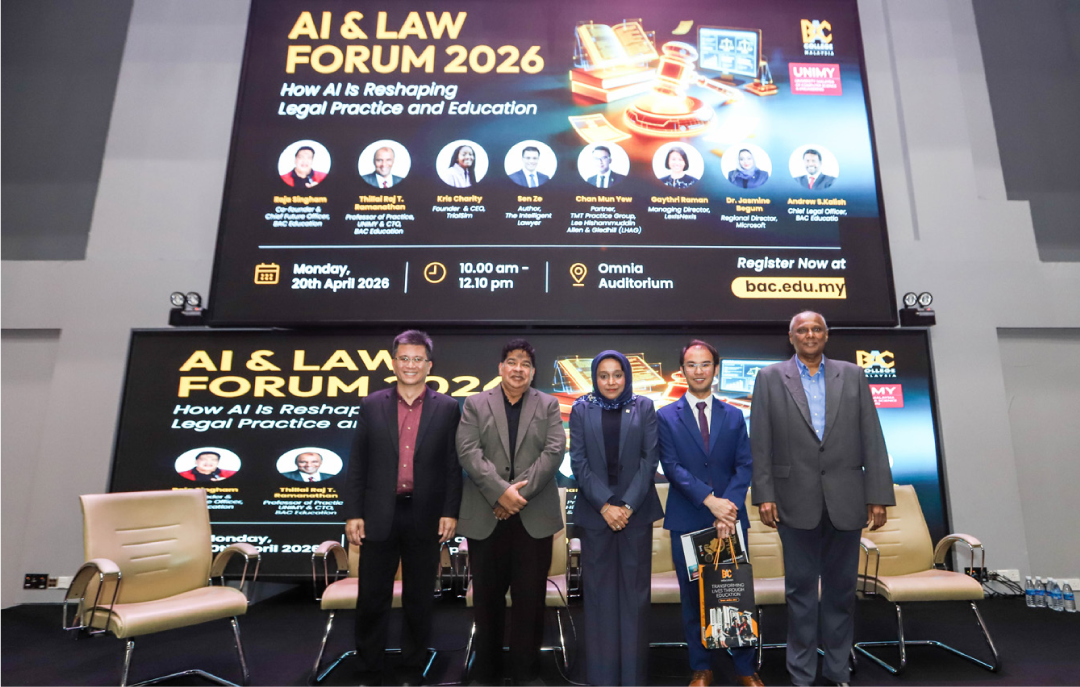
Part of the forum speakers – Sen Ze (Author, The Intelligent Lawyer), Raja Singham (Founder & Chief Future Officer, BAC Education Group), Dr. Jasmine Begum (Senior General Counsel, Corporate External & Legal Affairs, Microsoft ASEAN), Chan Mun Yew (Partner, TMT Practice Group, Lee Hishammuddin Allen & Gledhill) and Thillai Raj Ramanathan (Professor of Practice, UNIMY & CTO BAC Education)
The forum also provided a broader technological context. Thillai Raj Ramanathan traced AI’s development from a long period of slow progress to the rapid acceleration seen in recent years, especially after deep learning, transformers, and generative AI entered mainstream use. His presentation showed that AI is no longer limited to assisting tasks but is moving towards acting through more agentic systems. Yet this expanding capability also raises questions about governance, bias, and accountability, particularly in professional domains such as law where consequences are serious and public trust is critical.
From the perspective of legal practice, several speakers highlighted both the opportunities and the limits of AI. Sen Ze reminded the audience that AI does not think or understand in the human sense. It infers patterns and produces plausible outputs, but it does not carry responsibility. Chan Mun Yew similarly noted that AI may improve legal research, documentation review, and technical efficiency, but it cannot replicate advocacy, empathy, intuition, or strategic judgment. Gaythri Raman extended this discussion into legal education, warning that over reliance on AI may weaken core skills if students use it to bypass thinking rather than strengthen it. Dr. Jasmine Begum then widened the lens further by showing how AI and cybersecurity are now deeply connected, with rising cyber threats making resilience, compliance, and legal preparedness more important than ever.
Overall, the AI and Law Forum 2026 succeeded in positioning AI not as a threat to the legal profession, but as a test of its willingness to evolve. The forum made it evident that the future belongs not to those who resist technology blindly, nor to those who trust it uncritically, but to those who can combine legal knowledge, technological fluency, and sound human judgment in a responsible and credible manner.
Readers are invited to continue to the following pages for a structured account of each presentation and its key arguments.


More for You

Write for Rights 2026: Advocating Justice Together

ULaw Open Day at BAC: Mastering Advocacy and the BPC Journey

An exclusive visit to Rahmat, Lim & Partners

Courtroom Tales of Ethics, Advocacy, & Domestic Violence with The Hon. Professor...