The Role of the Judiciary in a Plural Society
What happens when the values we hold come into conflict?
Individual rights can come up against public interest. Religious principles can intersect with constitutional rights. Majority sentiment can clash with minority protections. And the power of the state can sit uneasily alongside individual liberty.
In a society as diverse as Malaysia, these tensions are not hypothetical. They are part of the complex reality of living together across different religions, ethnicities, languages, traditions, histories and beliefs. When those values collide, the judiciary is often where some of society’s most difficult questions ultimately land.
That was the starting point for The Role of the Judiciary in a Plural Society, which brought together legal practitioners, academics, students and members of the public to examine what the judiciary means — and what it must protect — in a society where people may not always agree.
Setting the Stage
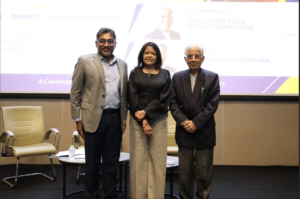
The session opened with emcee Mr Nathan Tharmalingam, law lecturer, as he welcomed the audience before introducing Mr. Raja Singham, Chief Future Officer and Co-Founder of BAC Education Group, for the opening remarks.

Mr. Raja Singham began by reflecting on the reality of Malaysia as a plural society. While the country’s different communities often coexist peacefully, there are moments when their values and interests inevitably collide.

When they do, judges face questions that go beyond simply asking, “What does the law say?”
They must consider what justice requires, where constitutional boundaries lie, whose rights must be protected, and how people can continue to live together when they profoundly disagree.
For Mr Raja Singham, this makes the judiciary’s role an extraordinarily difficult balancing act.
Judges must remain independent while still operating within a broader system of government. They must respect Parliament while upholding the Constitution. They must be prepared to make decisions that may be unpopular — including decisions that may be unpopular with those in power.
That independence, he stressed, is fundamental to public confidence in the courts.
People must believe they will receive a fair hearing and that the same principles apply regardless of who is before the court — whether a government, a powerful institution or an ordinary individual.
From the Bench: Tan Sri Nallini’s Perspective
Following Mr Raja’s remarks, Nathan returned to introduce the next part of the session and passed the conversation to Sudharsanan Thillainathan, Partner at Adnan Sundra & Low, who moderated the dialogue.
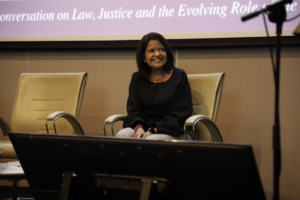
Mr Sudharsanan then invited Tan Sri Datuk Nallini Pathmanathan, former Judge of the Federal Court of Malaysia and currently a Judge of the Qatar International Court & Dispute Resolution Centre, to share her perspective.
With extensive experience on the bench, Tan Sri Nallini brought the discussion into the practical realities of judicial decision-making. The judiciary’s role is not simply to apply legislation mechanically. Courts operate within a constitutional framework in which the Constitution is the supreme law, and judges must ensure that laws and government action remain within those boundaries.
But constitutional adjudication can become particularly challenging when the issues before the court involve deeply held beliefs, religious questions, individual rights or competing conceptions of equality and justice.
It is in these moments that judicial independence becomes especially important.
A judge may have to make a decision that is unpopular, misunderstood or criticised. Yet the responsibility remains to decide according to law and reason — rather than fear, favour, politics or public pressure.
A Constitutional Perspective: Prof Shad
The conversation then returned to Sudharsanan, who brought the discussion to another perspective before inviting Emeritus Prof Datuk Dr Shad Saleem Faruqi, former holder of the Tunku Abdul Rahman Chair at the University of Malaya, to speak.
Where Tan Sri Nallini offered insight shaped by experience from the bench, Prof Shad approached the question through the lens of constitutional scholarship and Malaysia’s history as a plural society.
Malaysia’s constitutional framework was developed around the reality that different communities, interests and identities would have to coexist.
The Constitution therefore serves a purpose beyond defining legal powers. It forms part of the architecture that allows a diverse society to live together, establishing principles and safeguards intended to protect rights while maintaining social order.
For the judiciary, this creates an important responsibility — but also an important boundary.
Courts must uphold the rule of law and protect constitutional principles, particularly where vulnerable or marginalised groups may be affected. At the same time, the judiciary cannot simply take over the role of Parliament or become a political institution.
The challenge is knowing where that line lies.

When Two Perspectives Meet
With both perspectives on the table, Mr Sudharsanan moved the session into its panel discussion.
The conversation shifted from what the judiciary is expected to do in principle to the harder question of how judges navigate these responsibilities in a plural society.
What makes judging in a diverse society different from judging in a more homogeneous one? Can judges truly set aside their personal values when faced with difficult constitutional or religious questions?
Does judicial independence only mean freedom from political interference, or must it also protect judges from pressure coming from the media, public opinion or majority sentiment?
These questions brought the discussion closer to the human reality behind judicial decision-making.
Judges are individuals, but they occupy an institution whose decisions can affect far more people than those directly involved in a case. Their interpretation of constitutional and legal principles can influence how society understands rights, responsibilities and the boundaries of state power for years to come.

When Public Confidence Is Put to the Test
The discussion also considered one of the judiciary’s most difficult balancing acts: remaining independent while maintaining public confidence. In an age of social media and increasing polarisation, complex judgments can quickly be reduced to short clips, headlines or posts that leave little room for the reasoning behind a decision.
A two-minute explanation can travel further than the judgment itself.
For the judiciary, this creates a difficult environment. Courts cannot — and should not — make decisions simply because they are popular. Yet public understanding and confidence remain essential to the legitimacy of the institution.
That makes judicial independence about more than simply resisting political pressure. It also means having the institutional strength to uphold legal principles when doing so may attract criticism from powerful groups, public opinion or the wider community.
Justice Beyond the Courtroom
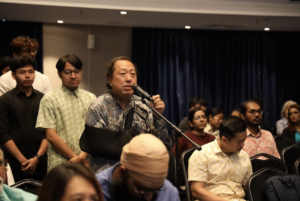
The panel discussion then opened into questions from the audience, bringing the conversation from constitutional principles to the realities faced by ordinary people.
One concern was access to justice.
Rights have little practical value if people lack the financial resources, legal knowledge or support needed to exercise them. This raised the importance of legal aid, structured support and pro bono assistance in ensuring that the justice system remains accessible beyond those who can afford extensive legal representation.
The Q&A also returned to the question of constitutional literacy.
Malaysia has a constitutional framework containing important protections and safeguards, yet many people may not fully understand what those protections are or how they work.
Perhaps, then, part of the challenge is not simply whether the Constitution provides sufficient safeguards, but whether society understands those safeguards well enough to recognise, exercise and defend them.

The Questions We Carry Forward
The conversation ultimately pointed to a reality that extends beyond the courtroom. A plural society does not become easier simply because its differences are acknowledged. The harder task is creating institutions and habits that allow those differences to coexist without undermining one another.
For the judiciary, that means independence, constitutional fidelity, fairness and the courage to make difficult decisions.
For society, it means understanding the institutions that protect those principles — and being willing to engage in difficult conversations without reducing disagreement to division.
That lesson becomes even more important as technology reshapes the legal profession.
Artificial intelligence can make legal research and drafting significantly faster, but it cannot determine what is right or wrong, reconcile competing freedoms or decide what justice should mean in a particular human context.
Those responsibilities still require human judgement, reasoning and empathy. Perhaps that is ultimately what the evening was asking its audience to consider.
We do not need to agree on everything to live together, but we do need strong institutions, strong principles and the willingness to listen to perspectives different from our own.
In a plural society, the strength of the judiciary is not measured only by the decisions it makes. It is also measured by whether people continue to believe that, when their values collide, there is an institution capable of hearing them fairly.
More for You

Write for Rights 2026: Advocating Justice Together
ULaw Open Day at BAC: Mastering Advocacy and the BPC Journey

An exclusive visit to Rahmat, Lim & Partners

Courtroom Tales of Ethics, Advocacy, & Domestic Violence with The Hon. Professor...