Order! Order! When Future Lawyers Took Their Seats in A Parliament Simulation
You can spend hours studying how Parliament works, memorising legislative procedures, and reading debates in constitutional law textbooks. But nothing quite compares to standing at the dispatch box, defending a bill while an Opposition waits to challenge every argument.
On 29th July 2026, Year 1 students from the University of London’s UK Transfer Law Programme (April 2026 intake), led by law lecturer Mr Nathan Tharmalingam, stepped beyond the classroom and into a parliamentary simulation that transformed legal theory into lived experience.
For one afternoon, the classroom became the Dewan Rakyat, complete with a Government, an Opposition, a speaker, cabinet ministers and a public gallery. More than a mock debate, it was an exercise in advocacy, critical thinking and the realities of democratic decision-making.
Bringing Parliament to Life
Dressed in formal black and white attire, the students debated a mock Education Reform Bill that they had drafted themselves. The proposed legislation explored how Malaysia’s education system might be structured, tackling questions surrounding vernacular schools, mother-tongue education and national education policy—topics that naturally invited strong opinions from both sides of the House.
Mirroring Parliament itself, students assumed the roles of Prime Minister, ministers overseeing portfolios such as Education, Higher Education, National Unity and Finance, alongside an Opposition front bench determined to scrutinise every proposal.
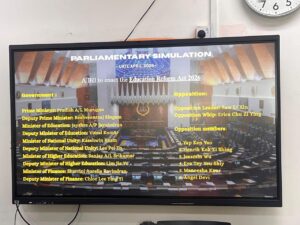
What followed was a lively exchange that quickly demonstrated the importance of preparation, persuasion, and composure under pressure.
Prime Minister, portrayed by Pradish A/L Murugan, opened proceedings with a confident defence of the Government’s position, carefully constructing his arguments while anticipating possible criticisms. Opposition Leader Saw Li Xin responded just as decisively, challenging his approach and accusing him of addressing arguments before they had even been raised—a strategic move that immediately shifted the momentum of the debate.
As the session progressed, both sides defended their positions with confidence, responding to questions on the spot while adapting their arguments in real time. Around them, the public gallery became fully immersed, applauding persuasive speeches and drumming their desks in support, creating an atmosphere remarkably like that of Malaysia’s own Parliament.
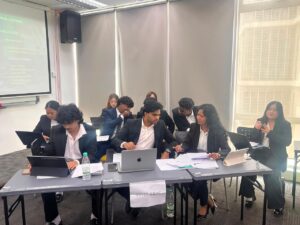
Learning the Discipline Behind Debate
Presiding over the session was Mr Nathan Tharmalingam, who assumed the role of Speaker.
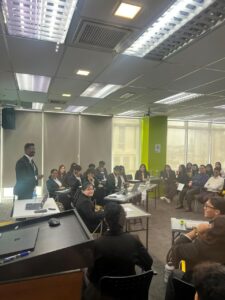
As debates grew increasingly spirited, he repeatedly called the House to order, reminded members to address all remarks through the Chair and ensured parliamentary decorum was maintained throughout the proceedings.
The simulation then moved into a clause-by-clause debate, where every provision of the proposed bill could be questioned, amended, or defended. Audience members were also invited to cast ballots evaluating which side had presented the stronger arguments, adding another layer of accountability to the exercise.
Reflecting on the session, Mr Nathan commended the students for embracing their roles with enthusiasm and professionalism. His advice was equally practical: strong arguments become even more persuasive when supported by solid facts, evidence and data—a lesson that will serve every aspiring lawyer well.
Lessons from Parliament Itself
The experience extended beyond the simulation with a special address by Mr Kishan Buxani, Special Functions Officer to the Speaker of the House of Representatives, Parliament of Malaysia, and himself a graduate of the University of London’s law programme.

Drawing from his own experience within Parliament, Mr Buxani explained the relationship between the legislative, executive, and judiciary, offering students a valuable perspective on how the institutions they study operate in practice.
More importantly, he reminded students that effective advocacy is not measured by volume, but by substance.
“Just because you’re loud, doesn’t mean you’re right,” he told the aspiring lawyers, encouraging them to approach public discourse with integrity, empathy and respect. Members of Parliament, he explained, carry the responsibility of representing the communities who place their trust in them, making honour and professionalism just as important as persuasive argument.
Preparing the Next Generation of Leaders
As one of the younger voices working within Parliament, Mr Buxani also shared his optimism about the potential of Generation Z.
He described today’s young Malaysians as principled, driven and eager to improve society, encouraging students not to be discouraged by those who tell them to “be realistic.” Instead, he challenged them to embrace ambitious goals, drawing inspiration from figures such as Abraham Lincoln, Steve Jobs and Michael Jordan, whose achievements were shaped by perseverance rather than convention.
To help students translate that ambition into meaningful action, he introduced them to the Malaysian Youth Parliament (Parlimen Belia Malaysia), where young Malaysians can form political parties, campaign, debate national issues and draft motions under the guidance of Members of Parliament.
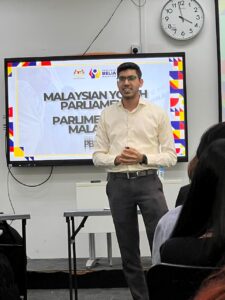
In a particularly encouraging development, students also learned that proposals debated within the Youth Parliament can now be channelled towards the Dewan Rakyat itself, giving young Malaysians an increasingly meaningful voice in shaping national conversations.
More Than a Classroom Exercise
While the parliamentary simulation concluded with the Speaker calling the House to a close, its lessons extended far beyond the day’s proceedings.
Students left with a deeper appreciation of the discipline behind legislation, the importance of respectful debate and the responsibility that comes with advocating for ideas that affect society.
For future lawyers, it was a rare opportunity to discover that the law is not simply something to study or memorise. It is something to question, defend and help shape.
And for one afternoon, Parliament was no longer confined to textbooks. It came alive in the classroom, preparing the next generation of legal professionals to one day stand where today’s lawmakers do.
More for You

Write for Rights 2026: Advocating Justice Together
ULaw Open Day at BAC: Mastering Advocacy and the BPC Journey

An exclusive visit to Rahmat, Lim & Partners

Courtroom Tales of Ethics, Advocacy, & Domestic Violence with The Hon. Professor...